فوكوئي (مدينة)
Fukui
福井市 | |||||||||||
|---|---|---|---|---|---|---|---|---|---|---|---|
| |||||||||||
 Flag  الشعار | |||||||||||
  Fukui | |||||||||||
| الإحداثيات: 36°3′50.6″N 136°13′10.5″E / 36.064056°N 136.219583°E | |||||||||||
| Country | Japan | ||||||||||
| Region | Chūbu (Hokuriku) | ||||||||||
| Prefecture | Fukui | ||||||||||
| الحكومة | |||||||||||
| • - Mayor | Shigeru Saigyō (since December 2023) | ||||||||||
| المساحة | |||||||||||
| • الإجمالي | 536٫41 كم² (207٫11 ميل²) | ||||||||||
| التعداد (July 1, 2017) | |||||||||||
| • الإجمالي | 264٬217 | ||||||||||
| • الكثافة | 490/km2 (1٬300/sq mi) | ||||||||||
| منطقة التوقيت | UTC+9 (Japan Standard Time) | ||||||||||
| Phone number | 0776-20-5111 | ||||||||||
| Address | 3-10-1 Ōte, Fukui-shi, Fukui-ken 910-8511 | ||||||||||
| Climate | Cfa | ||||||||||
| الموقع الإلكتروني | www | ||||||||||
| |||||||||||

.jpg&filetimestamp=20260115232235&)


Fukui (福井市, Fukui-shi, يابانية pronunciation: [ɸɯ̥.kɯꜜ(.)i, ɸɯ̥.kɯ(.)i, ɸɯ̥.kɯ.iꜜ.ɕi, ɸɯ̥.kɯꜜi.ɕi][1]) is the capital city of Fukui Prefecture, Japan. اعتبارا من 1 مارس 2024[تحديث], the city had an estimated population of 255,332 in 107,553 households.[2] Its total area is 536.41 متر كيلومربع (207.11 sq mi)[3] and its population density is about 476 persons per km2. Most of the population lives in a small central area; the city limits include rural plains, mountainous areas, and suburban sprawl along the Route 8 bypass. Having suffered devastation during World War II and an earthquake in 1948, Fukui was nicknamed 'Phoenix City', symbolising its rebirth from ashes and destruction.[4]
استعراض
أفق المدينة
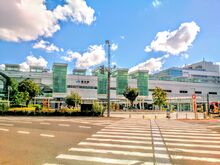
Fukui Station (2018)
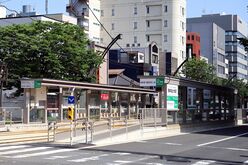
Downtown of Fukui City (2018)
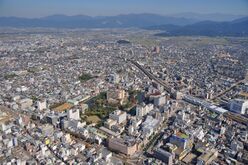
Fukui City Aerial (2014)
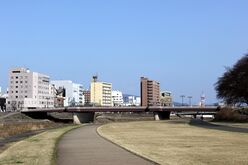
Skyline of Fukui City (2013)


الجغرافيا
Fukui is located on the coastal plain in the north-central part of the prefecture. It is bordered by the Sea of Japan to the west and the Ryōhaku Mountains to the east. The Kuzuryū River flows through the city.
المناخ
Fukui has a humid subtropical climate (Köppen climate classification Cfa) with hot, humid summers and cool winters. Precipitation is high throughout the year, and is especially heavy in December and January.
| بيانات المناخ لـ Fukui (1991−2020 normals, extremes 1897−present) | |||||||||||||
|---|---|---|---|---|---|---|---|---|---|---|---|---|---|
| الشهر | ينا | فب | مار | أبر | ماي | يون | يول | أغس | سبت | أكت | نوف | ديس | السنة |
| القصوى القياسية °س (°ف) | 19.9 (67.8) |
21.8 (71.2) |
26.6 (79.9) |
32.0 (89.6) |
34.9 (94.8) |
36.6 (97.9) |
38.6 (101.5) |
38.5 (101.3) |
37.7 (99.9) |
32.3 (90.1) |
28.0 (82.4) |
24.6 (76.3) |
38.6 (101.5) |
| متوسط القصوى اليومية °س (°ف) | 6.7 (44.1) |
7.8 (46.0) |
12.2 (54.0) |
18.3 (64.9) |
23.3 (73.9) |
26.5 (79.7) |
30.4 (86.7) |
32.2 (90.0) |
27.7 (81.9) |
22.1 (71.8) |
16.0 (60.8) |
9.8 (49.6) |
19.4 (66.9) |
| المتوسط اليومي °س (°ف) | 3.2 (37.8) |
3.7 (38.7) |
7.2 (45.0) |
12.8 (55.0) |
18.1 (64.6) |
22.0 (71.6) |
26.1 (79.0) |
27.4 (81.3) |
23.1 (73.6) |
17.1 (62.8) |
11.3 (52.3) |
5.9 (42.6) |
14.8 (58.6) |
| متوسط الدنيا اليومية °س (°ف) | 0.5 (32.9) |
0.3 (32.5) |
2.8 (37.0) |
7.8 (46.0) |
13.4 (56.1) |
18.2 (64.8) |
22.7 (72.9) |
23.7 (74.7) |
19.4 (66.9) |
13.1 (55.6) |
7.3 (45.1) |
2.7 (36.9) |
11.0 (51.8) |
| الصغرى القياسية °س (°ف) | −15.1 (4.8) |
−14.3 (6.3) |
−9.9 (14.2) |
−2.6 (27.3) |
1.3 (34.3) |
7.3 (45.1) |
12.8 (55.0) |
13.4 (56.1) |
7.7 (45.9) |
0.5 (32.9) |
−1.5 (29.3) |
−11.2 (11.8) |
−15.1 (4.8) |
| متوسط تساقط الأمطار mm (inches) | 284.9 (11.22) |
167.7 (6.60) |
160.7 (6.33) |
137.2 (5.40) |
139.1 (5.48) |
152.8 (6.02) |
239.8 (9.44) |
150.7 (5.93) |
212.9 (8.38) |
153.8 (6.06) |
196.1 (7.72) |
304.0 (11.97) |
2٬299٫6 (90.54) |
| متوسط هطول الثلج cm (inches) | 85 (33) |
58 (23) |
14 (5.5) |
0 (0) |
0 (0) |
0 (0) |
0 (0) |
0 (0) |
0 (0) |
0 (0) |
0 (0) |
31 (12) |
186 (73) |
| Average precipitation days (≥ 0.5 mm) | 24.3 | 20.0 | 17.4 | 13.3 | 12.0 | 11.9 | 13.5 | 9.9 | 12.4 | 13.4 | 17.5 | 23.5 | 189.2 |
| متوسط الرطوبة النسبية (%) | 82 | 78 | 71 | 68 | 68 | 74 | 76 | 73 | 76 | 76 | 78 | 81 | 75 |
| Mean monthly ساعات سطوع الشمس | 65.4 | 88.4 | 136.3 | 172.3 | 191.1 | 146.8 | 155.4 | 205.7 | 151.2 | 154.4 | 114.4 | 72.2 | 1٬653٫7 |
| Source: Japan Meteorological Agency[5] | |||||||||||||
| بيانات المناخ لـ Koshino, Fukui City (1991−2020 normals, extremes 1978−present) | |||||||||||||
|---|---|---|---|---|---|---|---|---|---|---|---|---|---|
| الشهر | ينا | فب | مار | أبر | ماي | يون | يول | أغس | سبت | أكت | نوف | ديس | السنة |
| القصوى القياسية °س (°ف) | 19.8 (67.6) |
21.4 (70.5) |
25.7 (78.3) |
30.5 (86.9) |
33.6 (92.5) |
36.1 (97.0) |
38.2 (100.8) |
37.7 (99.9) |
36.6 (97.9) |
31.1 (88.0) |
26.4 (79.5) |
22.9 (73.2) |
38.2 (100.8) |
| متوسط القصوى اليومية °س (°ف) | 8.1 (46.6) |
8.5 (47.3) |
11.9 (53.4) |
17.2 (63.0) |
22.0 (71.6) |
25.0 (77.0) |
29.3 (84.7) |
30.9 (87.6) |
26.8 (80.2) |
21.5 (70.7) |
16.4 (61.5) |
11.1 (52.0) |
19.1 (66.3) |
| المتوسط اليومي °س (°ف) | 5.5 (41.9) |
5.5 (41.9) |
8.2 (46.8) |
13.1 (55.6) |
17.8 (64.0) |
21.3 (70.3) |
25.7 (78.3) |
27.2 (81.0) |
23.4 (74.1) |
18.3 (64.9) |
13.3 (55.9) |
8.2 (46.8) |
15.6 (60.1) |
| متوسط الدنيا اليومية °س (°ف) | 2.9 (37.2) |
2.7 (36.9) |
4.8 (40.6) |
9.2 (48.6) |
14.0 (57.2) |
18.3 (64.9) |
22.8 (73.0) |
24.3 (75.7) |
20.6 (69.1) |
15.6 (60.1) |
10.4 (50.7) |
5.5 (41.9) |
12.6 (54.7) |
| الصغرى القياسية °س (°ف) | −3.8 (25.2) |
−4.7 (23.5) |
−1.2 (29.8) |
0.6 (33.1) |
6.9 (44.4) |
10.1 (50.2) |
16.2 (61.2) |
17.6 (63.7) |
13.6 (56.5) |
6.9 (44.4) |
1.5 (34.7) |
−1.3 (29.7) |
−4.7 (23.5) |
| متوسط تساقط الأمطار mm (inches) | 218.4 (8.60) |
139.8 (5.50) |
156.6 (6.17) |
143.0 (5.63) |
157.6 (6.20) |
157.8 (6.21) |
225.7 (8.89) |
146.7 (5.78) |
230.2 (9.06) |
166.1 (6.54) |
173.6 (6.83) |
253.8 (9.99) |
2٬169٫4 (85.41) |
| Average precipitation days (≥ 1.0 mm) | 23.6 | 18.3 | 15.5 | 12.0 | 11.3 | 11.3 | 12.4 | 8.7 | 11.8 | 11.8 | 15.7 | 23.0 | 175.4 |
| Mean monthly ساعات سطوع الشمس | 46.2 | 72.7 | 132.9 | 176.3 | 194.2 | 145.9 | 163.9 | 215.4 | 150.4 | 138.8 | 96.7 | 53.8 | 1٬587٫3 |
| Source: Japan Meteorological Agency[6][7] | |||||||||||||
Neighbouring municipalities

السكان
Per Japanese census data, the population of Fukui has remained relatively steady over the past 40 years.
| السنة | تعداد | ±% |
|---|---|---|
| 1873 | 39٬784 | — |
| 1970 | 231٬901 | +482.9% |
| 1980 | 259٬638 | +12.0% |
| 1990 | 270٬911 | +4.3% |
| 2000 | 269٬557 | −0.5% |
| 2010 | 266٬796 | −1.0% |
| 2020 | 262٬328 | −1.7% |
| Source: Fukui population statistics, Japanese Imperial Commission [1] (1873) | ||
التاريخ
الأصول
Fukui originally consisted of the old provinces of Wakasa and Echizen, before the prefecture was formed in 1871.[8]
During the Edo period, the daimyō of the region was surnamed Matsudaira, and was a descendant of Tokugawa Ieyasu.[9]
Sengoku period
In 1471, Asakura had displaced the Shiba clan as the shugo military commander of Echizen Province.[10] The same year, Asakura Toshikage (1428–1481) fortified the Ichijōdani by constructing hilltop fortifications on the surrounding mountains and constructing walls and gates to seal off the northern and southern end of the valley. Within this area, he contracted a fortified mansion, surrounded by the homes of his relatives and retainers, and eventually by the residences of merchants and artisans, and Buddhist temples. He offered refuge to people of culture or skills from Kyoto attempting to escape the conflict of the Ōnin War, and the Ichijōdani became a major cultural, military, and population center, and by the time of Asakura Takakage (1493–1548) it had a peak population of over 10,000 inhabitants. Yoshikage succeeded his father as head of the Asakura clan and castle lord of Ichijōdani Castle in 1548.[11][12]
The Asakura maintained good relations with the Ashikaga shogunate, and thus eventually came into conflict with Oda Nobunaga. Following Nobunaga's capture of Kyoto, Shōgun Ashikaga Yoshiaki appointed Asakura Yoshikage as regent and requested aid in driving Nobunaga out of the capital.[13] As a result, Nobunaga launched an invasion of Echizen Province. Due to Yoshikage's lack of military skill, Nobunaga's forces were successful at the Siege of Kanegasaki and subsequent Battle of Anegawa in 1570, leaving the entire Asakura Domain open to invasion.[10][14][15]
Ichijōdani was razed to the ground by Nobunaga during the 1573 Siege of Ichijōdani Castle.[16]
Kitanosho Castle is known, though that it was built by Shibata Katsuie in 1575. Also, it appears that the tenshu (keep) was nine stories high, making it the largest of the time.
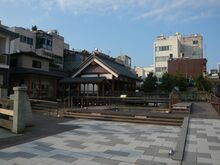
Kitanosho Castle(Sibata Jinja)


فترة إدو
Castle town and centre of Fukui Domain during the Edo period Tokugawa shogunate. Fukui Domain played a key role in the Meiji restoration. The modern city of Fukui was founded with the creation of the modern municipalities system on April 1, 1889.


Meiji, Taisho, and Showa periods
During the pre-war period, Fukui grew to become an important industrial and railroad centre. Factories in the area produced aircraft parts, electrical equipment, machine motors, various metal products, and textiles.
Fukui was largely destroyed on June 19, 1945 during the Bombing of Fukui during World War II. Of the city's 1.9 sq mi (4.9 km2) at the time, 84.8% of Fukui was destroyed, per the United States Army Air Forces's Strategic Bombing Survey.
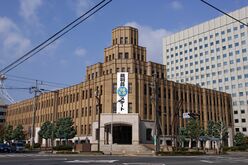
Fukui District Court
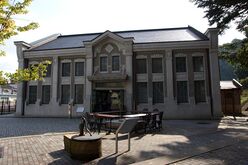
Fukui City Water Service Memorial
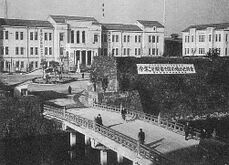
Fukui Prefectural Office Building (1923)


Modern Fukui
Fukui was again devastated by a major earthquake in 1948.
On February 1, 2006, the town of Miyama (from Asuwa District), the town of Shimizu, and the village of Koshino (both from Nyū District) were merged into Fukui.
Fukui's city status was designated a core city on April 1, 2019.[17]
الحكومة

Fukui has a mayor-council form of government with a directly elected mayor and a unicameral city legislature of 32 members. The city also contributes 12 members to the Fukui Prefectural Assembly. In terms of national politics, Fukui forms part of Fukui 1st district, a single-member constituency of the House of Representatives in the national Diet of Japan.
العلاقات الدولية

المدن الشقيقة
International
- Sister cities
| City | Country | State | since |
|---|---|---|---|
 New Brunswick New Brunswick
|
 United States United States
|
New Jersey
|
May, 1982 |
 Fullerton Fullerton
|
United States
|
 California California
|
November, 1989 |
- Friendship cities
| City | Country | State | since |
|---|---|---|---|
 Hangzhou Hangzhou
|
China
|
Zhejiang
|
November, 1989 |
 Suwon Suwon
|
 South Korea South Korea
|
 Gyeonggi Gyeonggi
|
April, 2001 |
National
- Sister cities
| City | Prefecture | region | since |
|---|---|---|---|
 Kumamoto Kumamoto
|
 Kumamoto Kumamoto
|
Kyūshū region | November, 1994 |
- Friendship cities
| City | Prefecture | region | since |
|---|---|---|---|
 Yūki Yūki
|
 Ibaraki Ibaraki
|
Kantō region | April, 2002 |
- Partnership cities
| City | Prefecture | region | since |
|---|---|---|---|
 Nagano Nagano
|
 Nagano Nagano
|
Chūbu region | August 9, 2013 |
Economy


The economy of Fukui is mixed. The city is a regional commercial and finance centre; however, manufacturing, agriculture and commercial fishing also are contributors to the local economy.
Primary sector of the economy
Agriculture
- Fukui Prefecture Agricultural Cooperatives (JA FukuiPrefecture)
Fishing industry
- FukuiCity Fisheries cooperative (JF FukuiCity)
Secondary sector of industry
Manufacturing industry
Fukui is home to several companies, including:
- Kumagai Gumi, a large general construction company, was founded and has its registered head office in the city.[19]
- Matsuura Machinery, an international heavy machinery manufacturing company[20]
- Morinaga Hokuriku Dairy, a dairy products subsidiary of Morinaga Milk Industry
Tertiary sector of industry
Service industry
- Emori Shoji, a trading house with strong ties to China
- Keifuku Bus
التعليم

Universities and colleges
- Fukui College of Health Sciences
- Fukui Prefectural University
- Fukui University of Technology
- Jin-ai Women's College
- University of Fukui
المدارس الثانوية
- Asuwa Senior High School
- Fujishima Senior High School
- Fukui Commercial Senior High School
- Fukui Minami Senior High School
- Fukui Norin Senior High School
- Fukui University of Technology - Fukui Senior High School
- Hokuriku Senior High School
- Jin-ai Girl's Senior High School
- Kagaku-Gijutsu Senior High School
- Keishin Senior High School
- Koshi Senior High School
- Michimori Senior High School
- Usui Senior High School
Other schools
- Fukui Prefectural School for the Blind
- Fukui Prefectural School for the Deaf
- A North Korean school: Hokuriku Korean Elementary and Junior High School (北陸朝鮮初中級学校).[21]
Transport
_as.jpg&filetimestamp=20260115234850&)


Railways
High-speed rail
 West Japan Railway Company (JR West)
.svg&filetimestamp=20190219033610&)
Shinkansen service began on 16 March 2024, when the route was extended from Kanazawa in Ishikawa, north of Fukui Prefecture, to Tsuruga in the south of Fukui.[22]
Conventional lines
- West Japan Railway Company (JR West)
- Etsumi-Hoku Line (Kuzuryū Line): Echizen-Hanandō - Rokujō - Asuwa - Echizen-Tōgō - Ichijōdani - Echizen-Takada - Ichinami - Kowashōzu - Miyama - Echizen-Yakushi - Echizen-Ōmiya - Hakariishi
 Fukui Railway

- Fukubu Line: Sanjūhassha - Taichō no Sato - Asōzu - Harmony Hall - Seimei - Ebata - Bell-mae - Hanandō - Sekijūjimae - Shokokaigisho-mae - Asuwayama-Koenguchi - Fukui Castle Ruins-daimyomachi - Jin'ai Joshikōkō - Fukui
 Echizen Railway

- Mikuni Awara: Fukui - Shin-Fukui - Fukuiguchi - Matsumoto Machiya - Nishi-Betsuin - Fukui - Fukudaimae-Nishi-Fukui - Nikkakagaku-Mae - Yatsushima - Nittazuka - Nakatsuno - Jin'ai Ground-Mae - Washizuka-Haribara
- Katsuyama Eiheiji Line: Fukui - Shin-Fukui - Fukuiguchi - Echizen-Kaihotsu - Echizen-Shinbo - Oiwakeguchi - Higashi-Fujishima - Echizen-Shimabashi
Hapi Line Fukui
Service on the third-sector line formerly belonging to JR West began operations on 16 March 2024 when the Hokuriku Shinkansen was extended to Tsuruga.[23]
- Ōdoro - Echizen-Hanandō - Fukui - Morita
Roads
Expressways

Japan National Route


Air
The city does not have its own commercial airport. The nearest airport is served by Komatsu Airport which is located 55 km north of Fukui.[24]
Seaways
Sea Port
- Port of Takasu
Visitor attractions

- Asuwa River
- Fukui International Activities Plaza
- Harmony Hall Fukui
- Ichijōdani Asakura Family Historic Ruins, one of the most important cultural heritage sites in Japan
- Fukui Castle
- Fukui Fine Arts Museum
- Kitanosho Castle
- Peace Pagoda, the second of its kind in the world, inaugurated in 1959
- Yōkōkan Garden
- "Yoroppaken", creator of Fukui's trademark dish, sauce katsudon (ソースカツ丼)
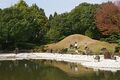
Yōkōkan Garden
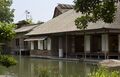
The Yōkōkan Kantei
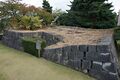
Fukui Castle
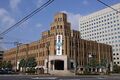
Fukui District Court
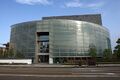
Fukui International Activities Plaza
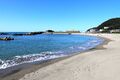
Koshino beach


Culture
Sports
Baseball
Handball
- Hokuriku Electric Power Company Blue Thunder (JHL)
Soccer
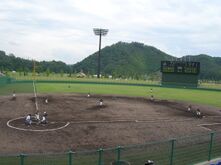
Fukui Phoenix Stadium
- Fukui Prefectural Gymnasium 20110617121141.jpg
Fukui Prefectural Gymnasium
- Technoport Fukui 20140504.JPG
- 2018年夏の福井県営陸上競技場.jpg
Fukui Prefectural sports Park (9.98 Stadium)
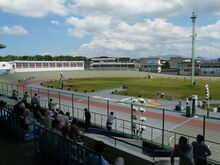
Fukui Velodrome


References
- ^ NHK Broadcasting Culture Research Institute, ed. (24 May 2016). NHK日本語発音アクセント新辞典 (in اليابانية). NHK Publishing.
- ^ "福井市人口統計". Fukui City. Retrieved 19 March 2024.
- ^ "令和4年度版 福井市統計書". Fukui City. Retrieved 19 March 2024.
- ^ "Fukui Japan". City of Fullerton.
- ^ 気象庁 / 平年値(年・月ごとの値). Japan Meteorological Agency. Retrieved May 19, 2021.
- ^ 観測史上1~10位の値(年間を通じての値). JMA. Retrieved April 2, 2022.
- ^ 気象庁 / 平年値(年・月ごとの値). JMA. Retrieved April 2, 2022.
- ^ Louis-Frédéric (2002). Japan Encyclopedia. Harvard University Press. ISBN 978-0-674-01753-5.
- ^ Louis-Frédéric (2002). Japan Encyclopedia. Harvard University Press. ISBN 978-0-674-01753-5.
- ^ أ ب "Asakura Yoshikage". Encyclopedia of Japan. Tokyo: Shogakukan. 2012. OCLC 56431036. Archived from the original on 2007-08-25. Retrieved 2012-08-22.
- ^ "朝倉 義景" [Asakura Yoshikage]. Nihon Jinmei Daijiten (日本人名大辞典) (in Japanese). Tokyo: Shogakukan. 2012. Archived from the original on 2007-08-25. Retrieved 2012-08-22.
{{cite encyclopedia}}: CS1 maint: unrecognized language (link) - ^ "朝倉 義景" [Asakura Yoshikage]. Nihon Kokugo Daijiten (in Japanese). Tokyo: Shogakukan. 2012. OCLC 56431036. Archived from the original on 2007-08-25. Retrieved 2012-08-22.
{{cite encyclopedia}}: CS1 maint: unrecognized language (link) - ^ "朝倉 義景" [Asakura Yoshikage]. Kokushi Daijiten (in Japanese). Tokyo: Shogakukan. 2012. OCLC 683276033. Archived from the original on 2007-08-25. Retrieved 2012-08-22.
{{cite encyclopedia}}: CS1 maint: unrecognized language (link) - ^ "朝倉義景" [Asakura Yoshikage]. Dijitaru Daijisen (in Japanese). Tokyo: Shogakukan. 2012. OCLC 56431036. Archived from the original on 2007-08-25. Retrieved 2012-08-22.
{{cite encyclopedia}}: CS1 maint: unrecognized language (link) - ^ Turnbull, Stephen (1987). Battles of the Samurai. Arms and Armour Press. p. 60. ISBN 978-0853688266.
- ^ "Ichijodani Asakura Family Site Museum". Retrieved 2017-10-10.
- ^ "平成31年4月 中核市『福井市』誕生!". Official website of Fukui. April 1, 2019. Retrieved April 7, 2019.
- ^ "市政情報". city.fukui.lg.jp (in اليابانية). Fukui. Retrieved 2020-04-11.
- ^ "Corporate Profile Archived 2017-12-09 at the Wayback Machine." Kumagai Gumi. Retrieved on August 31, 2017."
- ^ "Company Profile". Matsuura Machinery. Retrieved on May 7, 2019.
- ^ "Archived copy". www.hks35.ac.jp. Archived from the original on 21 November 2003. Retrieved 11 January 2022.
{{cite web}}: CS1 maint: archived copy as title (link) - ^ "Hokuriku Shinkansen's Kanazawa-Tsuruga extension set to open Saturday". The Japan Times (in الإنجليزية). 14 March 2024. Archived from the original on 14 March 2024. Retrieved 16 March 2024.
- ^ "並行在来線「ハピラインふくい」開業 記念グッズに目輝かせるファンも" [Parallel conventional line "Hapi-Line Fukui" opens as commemorative goods go on sale]. Fukui Keizai Shimbun. 16 March 2024. Retrieved 16 March 2024.
- ^ "Travel to Fukui".
External links

- Official website (in يابانية)
 Geographic data related to فوكوئي (مدينة) at OpenStreetMap

| International | |
|---|---|
| National | |


_as.jpg&filetimestamp=20260115234850)


- Pages using gadget WikiMiniAtlas
- CS1 uses اليابانية-language script (ja)
- CS1 اليابانية-language sources (ja)
- Short description is different from Wikidata
- Pages using multiple image with auto scaled images
- Coordinates on Wikidata
- Pages using infobox settlement with unknown parameters
- Pages with يابانية IPA
- مقالات فيها عبارات متقادمة منذ مارس 2024
- جميع المقالات التي فيها عبارات متقادمة
- Articles with hatnote templates targeting a nonexistent page
- Official website different in Wikidata and Wikipedia
- Articles with يابانية-language sources (ja)
- Fukui (city)
- Cities in Fukui Prefecture
- Port settlements in Japan
- Populated coastal places in Japan